Adam Wilson on Plot vs. “Concept” (and Why He’ll Never Write a Yankees Fan)
Story summary
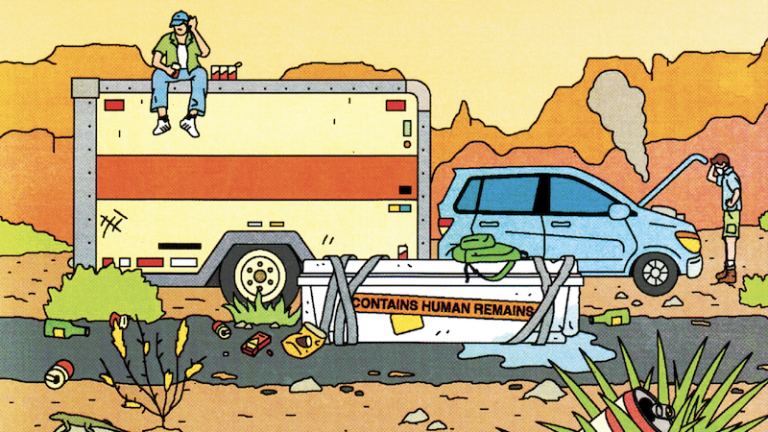
Despite being a book that revolves around a cryonically-frozen (dead) father being transported two thousand miles in the back of a U-haul, Adam Wilson’s Fail Sons is laugh-out-loud funny. It might be aimed at a certain subset of readers—it helps
📌 Key Highlights & Takeaways
- Despite being a book that revolves around a cryonically-frozen (dead) father being transported two thousand miles in the back of a U-haul, Adam Wilson’s Fail Sons is laugh-out-loud funny.
- It might be aimed at a certain subset of readers—it helps
Despite being a book that revolves around a cryonically-frozen (dead) father being transported two thousand miles in the back of a U-haul, Adam Wilson’s Fail Sons is laugh-out-loud funny. It might be aimed at a certain subset of readers—it helps if you know which unremarkable Pavement B-side became a viral TikTok hit—but it’s ultimately a story about being someone’s child and someone’s sibling and someone’s parent. Relatable! And also what’s it like to be a stressed-out person in this ridiculous country at this ridiculous time. At a svelte 224 pages, it’s Wilson’s tightest, funniest, most moving novel yet.
Critics and Wilson himself refer to Fail Sons as a “midlife-crisis” novel, which makes me feel older than I thought I was. But that’s neither here nor there. What’s here: I asked Wilson some pertinent questions over email as the September days grew chillier. We discussed the vulnerability of writing about aging bodies, Knicks fever, and how much Stanley Elkin is too much Stanley Elkin, among other hot topics. Our exchange has been condensed and edited for length.
Sam Axelrod: The bulk of Fail Sons is a cross country trip from Arizona to the East Coast. That’s a lot of geography to cover. What was your research process like? Did you leave the house or was it all from the comforts of your desk?
Adam Wilson: The initial inspiration was a road trip from Los Angeles to Denver that my wife (then girlfriend) and I took in 2014. I also spent a month at a residency in Woody Creek, Colorado the following year. I’d never been to Arizona, Utah or Colorado before, and the project began as a repository for my observations about those places, most of which were, like, whoa, what a beautiful landscape, who knew? (Many people knew.) I started writing it right after my first son was born. The plan was always to go back and retrace the route once I was farther along in the manuscript, but then the pandemic hit, and then I had another kid, and it became unfeasible. Thankfully, the internet exists. My copy editor, Sarah Lyn Rogers, was also a HUGE help with the geography, much of which I got wrong. One thing worth noting, is that my other books have all been set in places I’ve lived, and I wrote them with a local’s authority. Here, I was cognizant of writing as an outsider. The narrator, Scott, views everything from behind a car window, not from inside a community. I think there’s something interesting about looking at a place through a visitor’s eyes, though of course I worry that anyone local to the book’s various settings will only see my mistakes, just as I’m constantly complaining about bad Boston accents in Hollywood films.
SA: Because of the, shall we say, political situation in this country, as well as the pandemic, 2019 is very different from 2020, is very different from 2021, and so on. How’d you decide to set the book in the summer of 2022?
AW: I wanted the pandemic to be far enough in the rearview that it’s no longer the central event of the character’s lives, but recent enough that they’re still feeling its reverberations. In thinking about my coastal elites traveling across America, it was a useful source of animating tension to have a character—Scott’s brother, Nick—who’s still very anxious about getting Covid. It started off as a joke—it’ll be funny if this guy wears a KN95 in a red-state Walmart—but I ended up getting more mileage out of it, plot-wise, than I thought I would. The pandemic screwed up everyone’s lives in different ways. Single people had very different pandemics than married people, and married people with no kids had very different pandemics than married people with kids, and that doesn’t even account for divorced people, or stepparents, or hospital workers, or people with serious medical conditions, etc. I wanted to capture something of that chasm in the novel. The pandemic has shaped both brothers’ lives, but in such vastly different ways that they find it nearly impossible to relate to one another.
SA: This novel is told in a more fragmented way than your previous ones. There’s a lot of white space on the page. Among other things, this makes for a particularly propulsive read. How’d you settle on this form?
AW: I really love Mary Robison’s Why Did I Ever , and I wanted to model the book after its structure. This didn’t end up happening— Fail Sons is much more linear, for one—but the white space allowed me to jump back and forth between the novel’s present and scenes from Scott’s past without my having to expend a lot of verbiage on transitions. It also accommodated short scenes. One thing I love that Robison does is set up a joke, but then end the section before offering the punchline. The result is that her whole novel is colored by a sense of irresolution. I was trying to achieve a similar effect.
Editorial Text & Content Analyzer
Analyze real-time word count, reading speed, and text density metrics on the fly.
Source: Literary Hub.
Read the full story at the original source ↗
For questions: mrsmithcons@gmail.com.
❓ Frequently Asked Questions (Author Craft Briefing)
What core principle or progressive framework underpins this Author Craft guide?
Whether analyzing biomechanical motor recruitment for bodyweight leverage or structural narrative arcs in fiction, success relies on progressive progressive mastery of foundational fundamentals.
How should practitioners structure their training or reading schedule?
Implement structured 4-to-6 week periodization blocks with scheduled deloads or chapter deconstructions to ensure optimal neuromuscular and cognitive retention.
What common misconceptions should beginners avoid?
Avoid rushing into advanced progressions or skipping thematic world-building; foundational volume builds the tendon resilience and conceptual depth required for mastery.
📖 Full Essay Manuscript & Author Commentary
Complete uncut narrative text, historical footnotes, and reading guides.
⚡ Read Full Manuscript ➔More from SkyFree Chronicles


 💎 LuxeLiving 768
Warum ein äußerst seltener Supersportwagen, von dem Sie noch nie gehört haben, bei einer Auktion 1,35 Millionen US-Dollar einbringen könnte
Monte Carlo Automotive baute nur 16 Exemplare des Centenaire, der vom gleichen Motor wie der Lamborghini Count...
 ✈️ SkyFree Club
British Airways rüstet A380 mit völlig neuen Sitzen und der größten Business-Class-Kabine der Welt nach
British Airways hat neue Kabinen für seine nachgerüsteten Airbus A380 vorgestellt, darunter eine neu gestaltet...
 ⚡ SkyFree Athletics
These Comfortable Open-Ear Headphones Are Perfect for Long Runs—and They're 22% Off for Prime Day Big Deal Days
If earbuds never fit quite right, these open-ear, over-the-ear headphones offer all-day comfort, impressive au...
 🌿 SkyFree Living
Dragon Fairfax 20: A Compact Tiny House with a Full Kitchen, Laundry, and Lofted Bed
Dragon Tiny Homes' Fairfax 20 fits a full kitchen, a washer-dryer combo, a bathroom, and a lofted bed over a c...