Why Barbara Kingsolver Writes Standing Up
Story summary
Partita, by Barbara Kingsolver, is available now from Harper, so we asked her a few questions about her writing life. * What time of day do you write (and why)? Once I’m seriously into a writing project, I tend to wake
📌 Key Highlights & Takeaways
- Partita, by Barbara Kingsolver, is available now from Harper, so we asked her a few questions about her writing life.
- * What time of day do you write (and why)?
- Once I’m seriously into a writing project, I tend to wake
Partita, by Barbara Kingsolver, is available now from Harper, so we asked her a few questions about her writing life.
What time of day do you write (and why)? Once I’m seriously into a writing project, I tend to wake up before dawn with words flooding into my brain. I let them pool in there until it feels like they might leak out, then I run to my desk to start pouring them into the keyboard. I only break to go to the kitchen and refill my coffee cup, no other distractions until lunchtime. If things are going well, I’ll forget lunch and keep going until early evening. The flow state is so blissful, I forget that I have a body. Very often, my darling husband Steven will quietly deliver a sandwich to my desk. Otherwise I would surely have perished by now.
How do you tackle writer’s block? When I’m trying to get a new book started, every single time, I somehow convince myself it’s the stupidest thing anybody has ever written. Ev-ver. It’s paralyzing. The only way out is to give myself permission to write a terrible first draft. Just do it! Badly! After all, nobody’s going to see it. It won’t leave my office until it has been rewritten a dozen or fifty times, slowly progressing from stupid to decent to the book I want it to be.
What’s the best or worst writing advice you’ve ever received? Francine Prose gave me this, a very long time ago: “The first sentence (or paragraph) of a novel should make a promise that the rest of the book will keep.” It’s brilliant. It forces you, the writer, to get very clear with yourself about your intentions, right from the start. You will not be wasting the reader’s time. I will die on that hill.
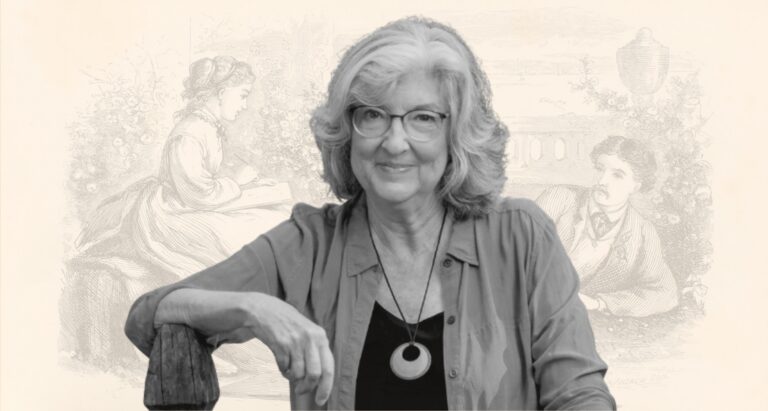
What part of your writing routine do you think would surprise your readers? I write standing up. I used to sit, like any normal desk drone, and I was plagued by terrible back problems for decades. Then the day came, two weeks before a drop-dead deadline on a final draft of a novel, when the pain was yelp-out-loud excruciating in any position other than lying flat on the floor, or standing. I rigged a prop-up thing for my computer and finished the book standing. It went so well, I ordered a proper standing desk, and have been pain free ever since. My last half dozen books have been produced by a woman entirely on her feet.
What was the first book you fell in love with (why)? In the way-back of my family’s station wagon when I was nine, on one of those interminable vacations where the parents want the kids to behave while we drive a million miles to some Important Destination, I fell headlong into Little Women . I have a clear memory of waking up out of the book just long enough to look around and think: “I hope we NEVER get to the Grand Canyon.”
Partita by Barbara Kingsolver is available from Harper, an imprint of HarperCollins.
Editorial Text & Content Analyzer
Analyze real-time word count, reading speed, and text density metrics on the fly.
Source: Literary Hub.
Read the full story at the original source ↗
For questions: mrsmithcons@gmail.com.
❓ Frequently Asked Questions (Author Craft Briefing)
What core principle or progressive framework underpins this Author Craft guide?
Whether analyzing biomechanical motor recruitment for bodyweight leverage or structural narrative arcs in fiction, success relies on progressive progressive mastery of foundational fundamentals.
How should practitioners structure their training or reading schedule?
Implement structured 4-to-6 week periodization blocks with scheduled deloads or chapter deconstructions to ensure optimal neuromuscular and cognitive retention.
What common misconceptions should beginners avoid?
Avoid rushing into advanced progressions or skipping thematic world-building; foundational volume builds the tendon resilience and conceptual depth required for mastery.
📖 Full Essay Manuscript & Author Commentary
Complete uncut narrative text, historical footnotes, and reading guides.
⚡ Read Full Manuscript ➔More from SkyFree Chronicles


 💎 LuxeLiving 768
Grundlegende Blaupause: Wie Führungskräfte im Jahr 2026 Mega-Villen für eine ertragsstarke Leistung steuern
Umfassende redaktionelle Analyse für 2026 zu Mega Mansions auf LuxeLiving 768. Entdecken Sie wichtige strategi...
 ✈️ SkyFree Club
British Airways rüstet A380 mit völlig neuen Sitzen und der größten Business-Class-Kabine der Welt nach
British Airways hat neue Kabinen für seine nachgerüsteten Airbus A380 vorgestellt, darunter eine neu gestaltet...
 ⚡ SkyFree Athletics
These Comfortable Open-Ear Headphones Are Perfect for Long Runs—and They're 22% Off for Prime Day Big Deal Days
If earbuds never fit quite right, these open-ear, over-the-ear headphones offer all-day comfort, impressive au...
 🌿 SkyFree Living
Dragon Fairfax 20: A Compact Tiny House with a Full Kitchen, Laundry, and Lofted Bed
Dragon Tiny Homes' Fairfax 20 fits a full kitchen, a washer-dryer combo, a bathroom, and a lofted bed over a c...