The Artist’s Room Is Not a Neutral Space
Story summary
At the BFI, Ruby has barely finished showing her film before the tax is levied: which parts are real? The interviewer wants origins, autobiography, the little certificate of suffering audiences sometimes seem to require before they trust invention. Ruby thinks
📌 Key Highlights & Takeaways
- At the BFI, Ruby has barely finished showing her film before the tax is levied: which parts are real?
- The interviewer wants origins, autobiography, the little certificate of suffering audiences sometimes seem to require before they trust invention.
At the BFI, Ruby has barely finished showing her film before the tax is levied: which parts are real? The interviewer wants origins, autobiography, the little certificate of suffering audiences sometimes seem to require before they trust invention. Ruby thinks of Hitchcock putting a light inside Cary Grant’s glass of milk so that it glows. “Film’s an illusion,” she says. She says, too, “I invent things.” A perfectly good answer. Doomed.
The ritual is familiar enough to seem harmless. At readings, Q&As, profiles, and festival interviews, the question recurs: where the story came from, which character is secretly the maker, what was lived, what was borrowed, what was survived. Often this passes for intimacy. Sometimes it is intimacy. But the question has other manners too. It asks the artist to open the suitcase. Show us the wound. Declare the source. Tell us what you paid for this. A made thing is admired, then frisked for biography.
Imogen Crimp’s Give Me Everything You’ve Got takes that small public shakedown and builds a house around it. Ruby, a young filmmaker, is invited to the country home of Ellen, the celebrated feminist director she idolizes. Ellen offers what every young artist knows how to desire before knowing whether it is safe to want: attention, proximity, a desk, a view, a room in which to become serious. The offer is generous. That is the trouble. The danger begins before mentorship has separated itself from help.
Ruby’s longing for Ellen is embarrassing because it is so legible. Ellen is not merely successful; she is formative. Ruby found her films when she was young and learning to be angry. Ellen’s work taught Ruby something about how to look, which is to say something about how to be. To be noticed by such a person is not only to be professionally blessed. It is to have the self that art helped assemble acknowledged by one of its original makers. Ruby blushes when she sees Ellen in the audience. She imagines, with an awful inward brightness, Ellen saying she is proud.
This is where Crimp is merciful. She does not mock the wish. She knows that wanting to be chosen by power is not simply vanity with a better haircut. For a young artist, being chosen can alter the material facts. It can mean the fellowship, the introduction, the recommendation, the money, the confidence to keep going. It can mean the room. Ambition here is never cleanly separate from need.
Ellen’s invitation is almost maternal in its completeness. She books the train, sends a cab, waits outside the house. The house itself has the force of an institution pretending to be a home: red brick, roses, sash windows, grounds, stairs, rooms whose purposes are not immediately obvious. Ruby, who tutors rich children for money, knows enough to read the grammar. Excess becomes invisible to the people who inherit it. A room no one needs is not emptiness; it is class made spatial.
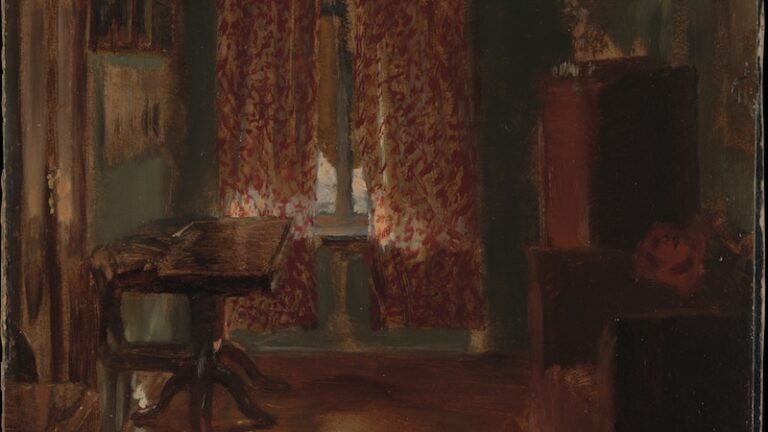
Then comes Ruby’s bedroom, the object at the center of the spell. Wooden floors, a woven rug, terra-cotta walls, a fireplace arranged with candles, a desk before an open window. Towels folded at the end of the bed. Blue flowers on the mantelpiece. Ruby thinks, “this room is mine,” and the sentence is lovely, foolish, and entirely understandable. The room is hers in the way a loan can be yours: intimately, temporarily, and with consequences arriving later in smaller print.
Virginia Woolf is not optional here, though she needn’t be allowed to take the best chair. A Room of One’s Own : the old Woolfian bargain of money, privacy, and time, the material dignity without which genius becomes another cruel joke played on the poor. Crimp does not sneer at that inheritance. Her novel is too serious about art, and too alert to precarity’s humiliations, to pretend that rooms do not matter. Ruby needs quiet. She needs money. She needs protection from rent, interruption, freelance panic, and the exhausting comic labor of appearing fine. The twist is not that the room is false. The twist is that this room comes from someone else’s house, someone else’s taste, someone else’s desire to supervise what Ruby might become.
Editorial Text & Content Analyzer
Analyze real-time word count, reading speed, and text density metrics on the fly.
Source: Literary Hub.
Read the full story at the original source ↗
For questions: mrsmithcons@gmail.com.
Immerse Yourself in Compelling Investigative Stories, Modern Poetry & Free Classical eBooks
A sanctuary for lovers of the written word: literary essays, long-form journalism, poetry chronicles, author craft breakdowns, and free public domain libraries.
Read Free Stories ➔📖 Full Essay Manuscript & Author Commentary
Complete uncut narrative text, historical footnotes, and reading guides.
⚡ Read Full Manuscript ➔More from SkyFree Chronicles


Amazing Plastic Bottle Recycling Idea | Easy DIY Home Decor Craft
Transform ordinary plastic bottles into stunning home decor with this quick and easy DIY craft! Instead of thr...
Hypercars Arriving - Huayra Codalunga, Agera RST, GMA T.50, Valkyrie Spider, Voltage SVJ, Spyker C8
We were in Costa Navarino, Greece to attend the Supercar Owners Circle weekend. This year it was held in Greec...
 ✈️ SkyFree Club
Big, Beautiful New “Flagship” SAS Lounge Copenhagen Opens June 2027
SAS is opening a bigger, more stylish flagship lounge at Copenhagen Airport in June 2027, with private work po...
 ⚡ SkyFree Athletics
The 10 Best Exercise Bikes for Low-Impact Workouts at Home
Cycle your way to becoming stronger, faster, and fitter without heavy impact....