What to read after you see the Bayeux Tapestry.
Story summary
The Bayeux Tapestry is now on display in England’s British Museum, and the hottest ticket in London right now is a chance to peek at a nearly century old piece of fabric art. Whether you’ve gotten to view the Tapestry,
📌 Key Highlights & Takeaways
- The Bayeux Tapestry is now on display in England’s British Museum, and the hottest ticket in London right now is a chance to peek at a nearly century old piece of fabric art.
- Whether you’ve gotten to view the Tapestry,
The Bayeux Tapestry is now on display in England’s British Museum , and the hottest ticket in London right now is a chance to peek at a nearly century old piece of fabric art. Whether you’ve gotten to view the Tapestry, or wish you could jaunt to the UK to see it, I’ve got a few recommendations of books to check out if you’ve got what British doctors call “Bayeux Fever,” which I’m afraid I may have.
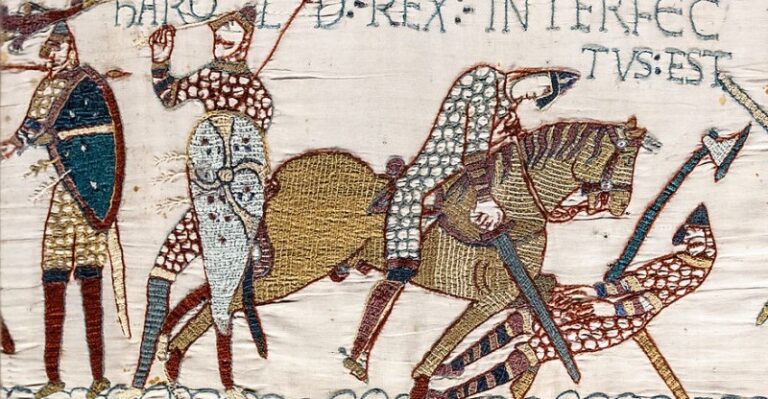
But first, a little primer. The Bayeux Tapestry is immense, nearly two feet wide and about as long as a 747. It’s embroidered onto cloth ( not woven on a loom so it’s not—pushing up my glasses—technically a tapestry) chronicles the events around the 1066 Norman Conquest of England by William the Conquerer, including the Battle of Hastings when William faced Harold II, the last Anglo-Saxon King of England. William’s half brother commissioned the piece to commemorate the conquest, thought it was likely woven by English nuns on the losing side of the war.
The history the Tapestry documents has deep meaning to the English, but the object itself has long been housed in a small museum Bayeux, France. Now, after years of diplomacy , the Tapestry has landed in London, where it’s been such a popular attraction that the museum is having to change how it manages the long lines.
While you’re waiting on those lines, how about something to read?
Matthew Gabriele and David M. Perry, The Bright Ages
I’ve recommended this book before and I stand by it: The Bright Ages is an immensely readable history and the sort of curious, engaged history that I love. The Middle Ages is a period freighted with the immense weight of outdated preconceptions. Gabriele and Perry’s book is wide-ranging, taking up a series of topics, figures, and moments for reevaluation, including the Vikings, the Black Death, Charlemagne, and much more.
The period of the pre-modern, pre-nation-state world didn’t just happen in Europe of course. Many kids in the West learn 1066, the date of the Norman Invasion depicted in Bayeux, but what about 1325, the founding of Tenochtitlan? Fifth Sun is a 2021 history that draws on new scholarship and a breadth of primary sources to present a more up-to-date and broad telling of Aztec history. Townsend is a great writer too, and includes some fictional flourishes to enliven her history.
Lyndal Roper, Summer of Fire and Blood
Editorial Text & Content Analyzer
Analyze real-time word count, reading speed, and text density metrics on the fly.
Source: Literary Hub.
Read the full story at the original source ↗
For questions: mrsmithcons@gmail.com.
❓ Frequently Asked Questions (Creative Nonfiction Briefing)
What core principle or progressive framework underpins this Creative Nonfiction guide?
Whether analyzing biomechanical motor recruitment for bodyweight leverage or structural narrative arcs in fiction, success relies on progressive progressive mastery of foundational fundamentals.
How should practitioners structure their training or reading schedule?
Implement structured 4-to-6 week periodization blocks with scheduled deloads or chapter deconstructions to ensure optimal neuromuscular and cognitive retention.
What common misconceptions should beginners avoid?
Avoid rushing into advanced progressions or skipping thematic world-building; foundational volume builds the tendon resilience and conceptual depth required for mastery.
📖 Full Essay Manuscript & Author Commentary
Complete uncut narrative text, historical footnotes, and reading guides.
⚡ Read Full Manuscript ➔More from SkyFree Chronicles



Supercars Accelerating - 1000HP GT-R, Novitec 812 Superfast, LOUD M3 G80, JCR GT3 RS, AMG GT R Pro
We went to The Netherlands to attend the Veluwe Drive. It was a tour with 50+ supercars and sportscars. In thi...
 ✈️ SkyFree Club
British Airways Retrofitting A380s With All-New Seats, World’s Biggest Business Class Cabin
British Airways has unveiled new cabins for its retrofitted Airbus A380s, including a redesigned first class s...
Top 5 Mens Gym Workout Mesh Shorts: Top 5 Best Sellers - Men Marathon Racing Gym Sports Shorts Anti escaping Lining Quic...
Best Top 5 Mens Gym Workout Mesh Shorts deals on AliExpress: 1. Men's Mesh Side Split Bodybuilding Workout Gym...
 🌿 SkyFree Living
Tiny Town Orlando on Lake Fairview: Lot Lease and Long-Term Rentals
About, as of 2026, prints lot-lease $650–$850 a month and furnished 6–12 month rentals $1,400–$2,300. The FAQ,...