A Journey to Antarctica in Photos: Remembering Ernest Shackleton’s Grand Expedition
Story summary
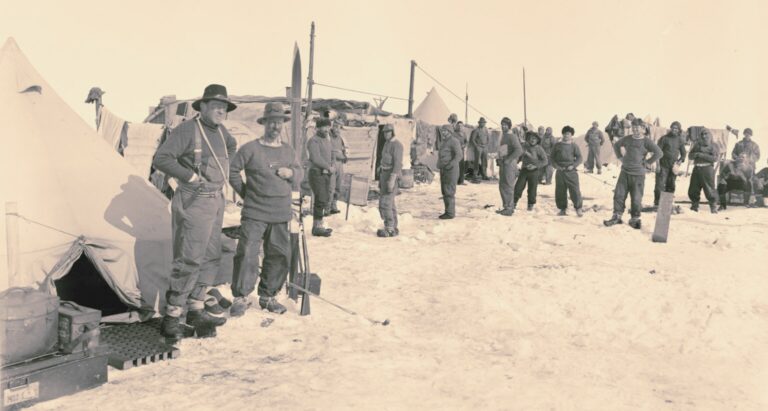
Among the treasures of the Royal Geographical Society’s two million strong collections are over 150 glass and celluloid negatives: the work of Frank Hurley, official photographer to Ernest Shackleton’s Imperial Trans-Antarctic Expedition of 1914-1917. These wonderful images have an importance
📌 Key Highlights & Takeaways
- Among the treasures of the Royal Geographical Society’s two million strong collections are over 150 glass and celluloid negatives: the work of Frank Hurley, official photographer to Ernest Shackleton’s Imperial Trans-Antarctic Expedition of 1914-1917.
- These wonderful images have an importance
Among the treasures of the Royal Geographical Society’s two million strong collections are over 150 glass and celluloid negatives: the work of Frank Hurley, official photographer to Ernest Shackleton’s Imperial Trans-Antarctic Expedition of 1914-1917. These wonderful images have an importance for me beyond their beauty and evocative power, because it was through them that I learned the story of my grandfather’s expedition aboard the Endurance .
I do not remember my father Eddie, Shackleton’s youngest child, ever sitting me down and telling me about his father. Indeed, he hardly knew him, being only 10 years old when Ernest died of a heart attack on January 5, 1922, during the Shackleton-Rowett Quest expedition.
I learned the story by asking about the Hurley photographs on the walls. They were sometimes confusing for a child: “Why was it dark when it was not night?” and “Why did all the men have beards?” I was particularly intrigued by one photograph showing Endurance in the ice, reduced to a skeleton, and the sled dogs sitting around her. I would ask, “What happened to the dogs?” The grownups would never give me a straight answer, and it was not until years later that I was deemed old enough to know the truth, that as on most expeditions of the era, the men killed and ate the dogs when food ran short.
It was not only children who were sometimes confused by a Hurley image. I remember one visitor spending ages contemplating a view of rocky, snow-covered peaks, brooding over a magnificent glacier tumbling into a large fjord, full of huge blocks of floating ice. Eventually, our visitor announced triumphantly, “I know where that is! It is Lulworth Cove!” Hereafter, it was known as Lulworth Cove in the family. In fact, it was South Georgia.
Hurley’s cine film South , originally released in 1919 as In the Grip of the Polar Pack-Ice, was also of significance for me, since it was the first time I saw my grandfather moving and smiling. The film shows astonishing images of the death of the Endurance . Hurley set cameras around her and showed her masts crashing down.
How did my grandfather come to select Frank Hurley to photograph the Endurance expedition? Hurley had been the official photographer on Douglas Mawson’s Australasian Antarctic Expedition of 1911-1913. Shackleton saw Hurley’s 1913 documentary film Life in the Antarctic and decided to recruit him. Departure date was nigh but Hurley—all unaware—was deep in the Australian bush. He thus became almost certainly the only polar photographer to be retrieved by an Aboriginal tracker.
Hurley was a superb photographer, not only for his vision but for his commitment. He would lie down in front of the moving ship and climb high in the mast, burdened with very heavy camera equipment. Results were all. Hurley regarded himself as primarily an artist rather than simply a recorder of events. He did not scruple on occasion to embellish his subject matter and to add or subtract details.
After the return of the expedition, Hurley went back to South Georgia to film penguins and seals. They were a novelty to the public then and Hurley felt his film did not contain enough footage. The success of the film enabled the expedition’s debts to be paid. From December 1919 to May 1920 Shackleton gave public lectures on the film, and twice daily he suffered the pain of seeing his ship lost.
Editorial Text & Content Analyzer
Analyze real-time word count, reading speed, and text density metrics on the fly.
Source: Literary Hub.
Read the full story at the original source ↗
For questions: mrsmithcons@gmail.com.
📖 Full Essay Manuscript & Author Commentary
Complete uncut narrative text, historical footnotes, and reading guides.
⚡ Read Full Manuscript ➔More from SkyFree Chronicles


 🌿 SkyFree Living
Rebuilding Stability: A Personal Journey
The intersection of mindful living and financial health: how addressing acute debt through community support r...
BUGATTI CHIRON ON YOUR WRIST! $1M+ W16 Tourbillon Masterpiece | Jacob & Co.
Jacob & Co Bugatti Chiron Tourbillon, Bugatti Chiron watch, Bugatti watch, Jacob and Co watch, Jacob & Co Buga...
 ✈️ SkyFree Club
Hotel Club Lounges: What They Are, And Why I Value Them So Much
A deep dive into hotel club lounges — what they offer, why quality varies so widely, and why I seek them out o...
15 Min Tai Chi Full Body Workout | Burn Calories & Lose Weight at Home
Get ready for a 15-minute full body Tai Chi workout you can easily do at home! 🧘♀️ This gentle, low-impact T...