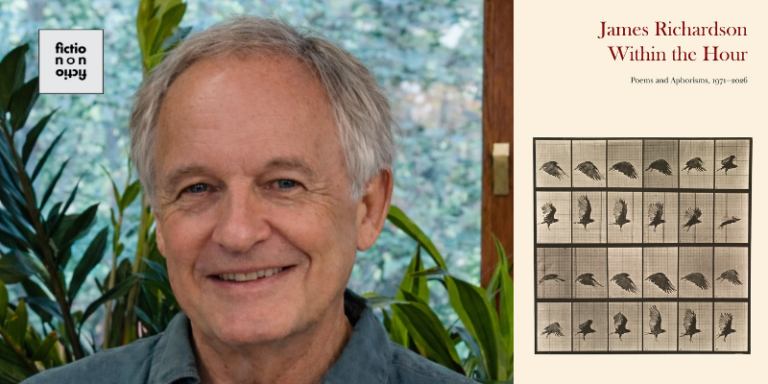
James Richardson on Within the Hour: Poems and Aphorisms, 1971-2026
Story summary
Poet James Richardson joins co-hosts Whitney Terrell and Christian Barter to talk about his collection of new and selected poetry, Within the Hour. Richardson discusses how his early fascination with science and his enjoyment of science fiction has influenced his
📌 Key Highlights & Takeaways
- Poet James Richardson joins co-hosts Whitney Terrell and Christian Barter to talk about his collection of new and selected poetry, Within the Hour.
- Richardson discusses how his early fascination with science and his enjoyment of science fiction has influenced his
Poet James Richardson joins co-hosts Whitney Terrell and Christian Barter to talk about his collection of new and selected poetry, Within the Hour. Richardson discusses how his early fascination with science and his enjoyment of science fiction has influenced his poetry and considers the way his aphorisms counterbalance his more lyric poems. He reflects on the role that literary criticism has played in his career as a poet and gives listeners a rare glimpse into his process of inspiration and composition. He speculates on the increasing role that politics has played in his new work, particularly since 2016, and reads from Within the Hour.
To hear the full episode, subscribe through iTunes, Google Play, Stitcher, Spotify, or your favorite podcast app (include the forward slashes when searching). You can also listen by streaming from the player below. Check out video versions of our interviews on the Fiction/Non/Fiction Instagram account , the Fiction/Non/Fiction YouTube Channel , and our show website: https://www.fnfpodcast.net This podcast is produced by Christian Barter, Whitney Terrell, Valen Williams, Ashley Holmes, Rylee Adamson, and Lucien Hockaday.
Within the Hour: Poems and Aphorisms, 1971-2026 • For Now • During • By the Numbers • Interglacial: New and Selected Poems and Aphorisms • Vectors: Aphorisms and Ten-Second Essays
“ Stopping by Woods on a Snowy Evening” by Robert Frost
EXCERPT FROM A CONVERSATION WITH JAMES RICHARDSON
Christian Barter: This collection goes back to 1971, and I just want to begin by asking what it’s like to put together a work that encompasses so much of the poetry in your life. You have a previous new and selected called Interglacial , published in 2004. Some of those poems are included here; others aren’t. I want to put in a quick plug to pick up that other book, Interglacial , because there’s some terrific poems in there that just wouldn’t fit in this one. But what was it like to put together a collection of this wide expanse? And did you discover things about your own work in doing that?
James Richardson: Well, it was fun. I did it with [my wife] Connie. She’s my in-house reader. She’s an awesome reader. She’s been reading my work for 50 years, so we just went through it and picked out stuff. I mean, I guess you learned a lot. I mean, I could be sad that 55 years fits in a book, even a little logbook, even if it’s only half of what I wrote.
Although I don’t think I am. I’m happy with the book. They tell you when you do this, you can’t revise your old poems. And I said the first time, “Oh yes, I can.” But you know what? They were right. You can’t do it because it’s never just like one little thing wrong with a poem, especially if it’s out of your reach. And in the past, you do a little surgery and you cut a nerve you didn’t even know was there, and then you have to do more and more. So the only way to revise old stuff is to either keep it or take it out. So I kept all that out, more than I maybe would have if I had felt free to have 300 pages and more, and maybe my publisher would have let me do that. But you don’t want to do that to readers.
Editorial Text & Content Analyzer
Analyze real-time word count, reading speed, and text density metrics on the fly.
Source: Literary Hub.
Read the full story at the original source ↗
For questions: mrsmithcons@gmail.com.
📖 Full Essay Manuscript & Author Commentary
Complete uncut narrative text, historical footnotes, and reading guides.
⚡ Read Full Manuscript ➔More from SkyFree Chronicles

Outdoor Case Bag Camping Leather Bushcraft Bag Vegetable Harve... -- Best Buy 2026 | Great Quality!
✨ Outdoor Case Bag Camping Leather Bushcraft Bag Vegetable Harvest Garden Fruit Picking Waist Tools Storage Ha...
 ⚡ SkyFree Athletics
The 10 Best Running Hydration Vests and Packs of 2026, Tested by Runners
Thirst isn't an issue when you've got multiple—and easily accessible—compartments for storing all your water....
Fun DIY Cactus Crafts to Refresh Your Home Decor
Explore creative cactus DIY crafts that instantly refresh your home decor. These cactus craft ideas are simple...
The EPIC Monaco Supercar Nightlife #40 - AMG ONE, Chiron Pur Sport, ONE:1, Mansory Urus
Over the past few years we went to Monaco many times over the summer. Monaco is an amazing country where you c...