O que três filmes recentes revelam sobre como vemos os poetas e a poesia
Story summary
Provavelmente já temos o filme definitivo sobre um artista desta década, em Peter Hujar’s Day, de Ira Sachs. A cinebiografia idiossincrática faz as escolhas certas, dando-nos, num lapso de tempo, a rotina de uma vida profissional com
📌 Key Highlights & Takeaways
- Provavelmente já temos o filme definitivo sobre um artista desta década, em Peter Hujar’s Day, de Ira Sachs.
- A cinebiografia idiossincrática faz as escolhas certas, dando-nos, num lapso de tempo, a rotina de uma vida profissional com
We probably already have the definitive film about an artist for this decade, in Ira Sachs’s Peter Hujar’s Day . The idiosyncratic biopic makes the right choices, giving us in a sliver of time the dailiness of a working life with its gossip, money worries, and ongoing projects dwindling or cresting or inching forward. Hujar is unsure of his prospects, curious where his talent and ambition might lead, embedded in a community that may or may not take him there.
The future looms, since the viewer knows what the characters in their filmic present do not: that the friends and peers we hear about will soon be devastated by the AIDS crisis; that Hujar’s reputation will be decades in growing; and that his photographs will reveal new dimensions when the years have done their work to make them a record of a city and sensibility hardly imaginable from our moment of hyper-gentrification, gross economic disparity, and anti-immigrant state violence. Yet it’s all there, incredibly, in the fading light of Linda Rosenkrantz’s apartment, the tape recorder picking up nuances that mean everything to the sensitive pair. Creative endeavor, in the space of a few hours, flashes its many faces, arduous and sexy, fleeting and fun.
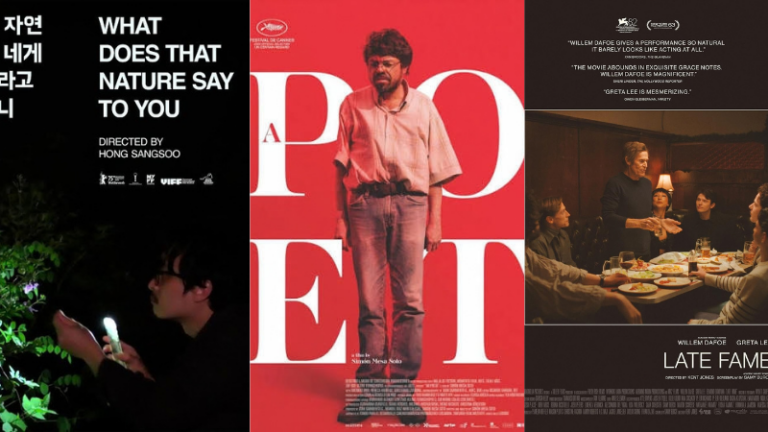
Knowing the experience might not quite measure up, I went with excitement to three films about poets over the past year: What Does That Nature Say to You , A Poet , and Late Fame . I wondered what the sudden flare of interest could mean, and what the stories would get right or very wrong. The world’s cynicism still surprises, as who would have imagined the glee with which we’d lately be encouraged to banish writing and declare it obsolete. Poet-characters are handy for asking whether resistance to this tide is worth it. But films need familiar plots, so the protagonists—all men—go searching for connection. Along the way, they recite their poems, none exactly amazing. Alcohol flows, rivalries scald, and humiliations pile up—a few prove transformative, while the rest are swallowed like medicine. The order in which I saw the films spiraled closer and closer to home.
New York’s public life, in this particular season, is sterile and uncompelling, while the streets of its past are so freighted with nostalgia they can feel exhausted and wrung dry.
The first was South Korean filmmaker Hong Sangsoo’s What Does That Nature Say to You . It begins inside a car, parked at the bottom of a driveway. Donghwa (Ha Seongguk) is dropping off his girlfriend, Kim Junhee (Kang Soyi). Curious, after three years of dating, about her family and their home in the countryside, he asks if he should come inside for once. She reluctantly agrees, and right away they encounter her father. He expresses admiration for Donghwa’s vintage car, then marches him up to see the beautiful gardens he’s created along the hillside behind the house, a labor of love to please his own ailing mother before she died.
Donghwa’s a poet. At thirty-five, he makes a meager living shooting wedding videos, though his attorney father is rich and famous enough to be known by Junhee’s family. Mother and sister appear receptive, and invite him in. Auspiciously, the mother is also a poet, her compositions framed and hung on the walls of the house. Donghwa, deferential and earnest, praises her verse. The family questions Donghwa, politely at first, about his career, about poetry, about his relationship with his father, and with increasing pressure about the wisdom of owning (and driving their Junhee around in) such an aging and possibly unreliable car. Donghwa mostly deflects, though over the course of the day he makes no secret of his ascetic principles or his real ardor for the natural world and the life of the mind.
By dinner, the soju and whiskey flowing, things have taken a harsher turn. Junhee’s sister confronts Donghwa outright about the foolishness of not taking money from his father. Cajoled into reciting a poem, he pronounces a short one, and it doesn’t land well. Finally, extremely drunk, the young writer explodes in rage, then passes out. The parents go up to a little outbuilding on their hill to trash him further. What’s maddening is that they’re also more or less artists, and the gap between the expression they feel entitled to and what they’ll tolerate in the younger generation surely has culturally specific resonance, but at the same time seems universally recognizable. The next morning, Donghwa and Junhee make some promises neither believe they’ll keep; he drives away, and the final scene finds him broken down by the side of the road, calling for roadside assistance.
Has the movie somehow justified, by stranding the poet, the family’s vain but common-sense view of life? Or is this merely another test of Donghwa’s idealism and resolve, the expected price to pay for those heightened encounters beholding trees and sky? We ourselves aren’t sure if he’s any good, or if he’s really equipped to hang in there until he gets better, or even in what context his poems circulate, if any. Earlier, before the disastrous dinner, he’d traveled with Junhee and her sister to contemplate stone pagodas erected in honor of the deceased. He points out that although the names of the honorees are long forgotten, the statues still stand and compel visitors to wonder.
Editorial Text & Content Analyzer
Analyze real-time word count, reading speed, and text density metrics on the fly.
Source: Literary Hub.
Read the full story at the original source ↗
For questions: mrsmithcons@gmail.com.
❓ Frequently Asked Questions (Author Craft Briefing)
What core principle or progressive framework underpins this Author Craft guide?
Whether analyzing biomechanical motor recruitment for bodyweight leverage or structural narrative arcs in fiction, success relies on progressive progressive mastery of foundational fundamentals.
How should practitioners structure their training or reading schedule?
Implement structured 4-to-6 week periodization blocks with scheduled deloads or chapter deconstructions to ensure optimal neuromuscular and cognitive retention.
What common misconceptions should beginners avoid?
Avoid rushing into advanced progressions or skipping thematic world-building; foundational volume builds the tendon resilience and conceptual depth required for mastery.
📖 Full Essay Manuscript & Author Commentary
Complete uncut narrative text, historical footnotes, and reading guides.
⚡ Read Full Manuscript ➔More from SkyFree Chronicles

 ✈️ SkyFree Club
United Explorer Card review: Premium perks without a premium fee
The United Explorer Card is one of the best mid-tier airline cards, thanks to its perks and ability to earn bo...
 ⚡ SkyFree Athletics
Apple Watch Ultra 4 Review: Is It the Best Watch for Most Runners? Maybe.
Apple finally built an Ultra that fixes the things that bugged me about its predecessor. It’s still not a Garm...
Survival Paracord Bracelet Adjustable U-Type Buckle Three-Hol... -- Amazing Value 2026 | Must Have!
🎯 Survival Paracord Bracelet Adjustable U-Type Buckle Three-Holes 550 Parachute Rope Outdoor Camping Hiking E...
 🛍️ Caylin Shop
Halloween Costume Reveals Are Taking Over TikTok — The Products Going Viral With Them
The Ramalama Costume Walk and the "Did I Win This Trend?" reveal are dominating October feeds. Here are the co...