Por que Frank O'Hara é perfeito para apresentar a poesia aos pré-adolescentes
Story summary
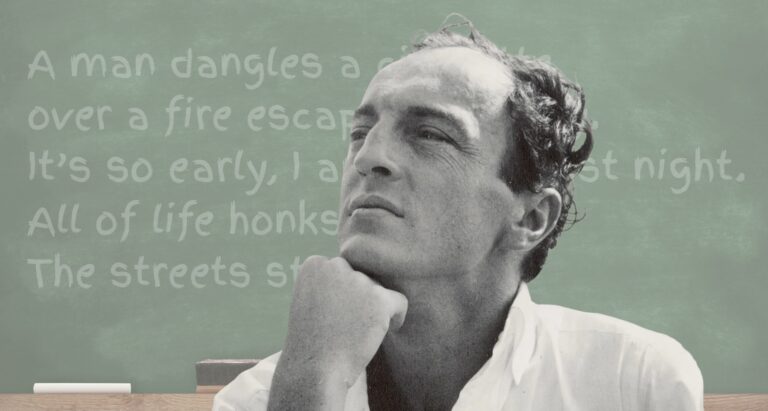
Quando dava aulas de poesia, sempre chegava com lápis, pedaços de papel e um poema impresso de Frank O’Hara. Se meus alunos, alunos do ensino médio forçados a amontoar-se em bibliotecas e salas de aula lotadas, já tivessem ouvido falar de algum poeta antes, O’Hara
📌 Key Highlights & Takeaways
- Quando dava aulas de poesia, sempre chegava com lápis, pedaços de papel e um poema impresso de Frank O’Hara.
- Se meus alunos, alunos do ensino médio forçados a amontoar-se em bibliotecas e salas de aula lotadas, já tivessem ouvido falar de algum poeta antes, O’Hara
When I taught poetry, I always arrived with pencils, pieces of paper, and a printed out poem by Frank O’Hara. If my students, middle schoolers forced to cram into libraries and over-filled classrooms, had heard of any poets before, O’Hara wasn’t one of them. With his short declarations and excited exclamations, he was a far cry from Robert Frost, Shel Silverstein, or anyone else past teachers had forced upon them.
Here, finally, was a poet without the careful composition that made poetry feel stuffy, like some hidden language adults pretended to understand. I watched their faces screw up with little laughs reading about Lana Turner’s fainting spell—a room full of twelve-year-olds giggling about 1950s movie gossip and an actress they had never heard of before. It was like an inside joke.
Anyone familiar with O’Hara’s work will recognize this feeling of camaraderie—there’s an immediacy to his work, an off-the-cuff wit that makes you, almost immediately, co-conspirators. In his artistic manifesto (which he wrote, in typical O’Hara fashion, in a single hour while Donald Allen was on his way to pick it up), he described writing a poem for a single person: as if he just as easily could have picked up a phone instead of a pen. It was unlike anything my students had read before.
How, amidst the poetic structure and planning they were used to, could it not change their idea of what poetry was? They weren’t alone. In the 100 years since his birth, and 60 since his death, generations of writers have found inspiration in his casual profundity. In many ways, he never stopped being the king of the New York art scene.
I asked them to be like Frank O’Hara, noticing colors and sounds and people we encountered.
O’Hara is most famous for his collection Lunch Poems , written in his lunch break as a receptionist from the Museum of Modern Art—proving even future curators/art critics must begin at the front desk. He’s often been called a painter’s poet, and, rejected by the conventional literary scene, found himself faster friends with the Abstract Expressionists than the literary world. Lunch Poems — reviewed by Ted Berrigan , as, emphatically “a great book!” and one of the “most important documents in contemporary poetry”—includes some of his most famous works, including “The Day Lady Died,” “Ave Maria,” and “A Step Away From Them.” This last one was my usual classroom pick. Selecting an eager student to read it aloud, a school’s worth of seventh graders would follow along on their printouts, as they began:
It’s my lunch hour, so I go for a walk among the hum-colored cabs. First, down the sidewalk where laborers feed their dirty glistening torsos sandwiches and Coca-Cola, with yellow helmets They protect them from falling bricks, I guess.
O’Hara called this style “I do this, I do that” poems. He had a name for it more broadly: Personism (“a movement which I recently founded and which nobody knows about”), marked not by the absence of ideas, but by the absence of thinking. “You just go on your nerve,” he wrote. “If someone’s chasing you down the street with a knife you just run, you don’t turn around and shout, ‘Give it up! I was a track star for Mineola Prep.’” You can picture him, walking down W 53rd, time ticking out on his lunch break, composing with a nerve so strong it poured out of him without trying.
Editorial Text & Content Analyzer
Analyze real-time word count, reading speed, and text density metrics on the fly.
Source: Literary Hub.
Read the full story at the original source ↗
For questions: mrsmithcons@gmail.com.
❓ Frequently Asked Questions (Author Craft Briefing)
What core principle or progressive framework underpins this Author Craft guide?
Whether analyzing biomechanical motor recruitment for bodyweight leverage or structural narrative arcs in fiction, success relies on progressive progressive mastery of foundational fundamentals.
How should practitioners structure their training or reading schedule?
Implement structured 4-to-6 week periodization blocks with scheduled deloads or chapter deconstructions to ensure optimal neuromuscular and cognitive retention.
What common misconceptions should beginners avoid?
Avoid rushing into advanced progressions or skipping thematic world-building; foundational volume builds the tendon resilience and conceptual depth required for mastery.
📖 Full Essay Manuscript & Author Commentary
Complete uncut narrative text, historical footnotes, and reading guides.
⚡ Read Full Manuscript ➔More from SkyFree Chronicles
 💎 LuxeLiving 768
4 Ultra-Rare F.P. Journe Watches Are Heading to Auction Next Month
Yes, it's going to be a blockbuster...and there's a very special Daytona consigned by Jerry Seinfeld, too....
 ✈️ SkyFree Club
Marriott Bonvoy Lounge: novo conceito chegando à Ásia-Pacífico, servindo “Bonvoy Bites”
O Marriott Bonvoy está testando um novo conceito de lounge nos hotéis da Ásia-Pacífico, mas não está claro se ...
Power of Calisthenics Part 1🥶☠️ #calisthenics #motivation #bodyweight #reaction #sigma #ego
Welcome to the world of Calisthenics 💪 credits - This video shows the real power of bodyweight training — str...
 🌿 SkyFree Living
Tiny Life Eagle: uma casa de 690 pés quadrados com dois quartos e dois banheiros em Peaceful Meadows
Tiny Life's Eagle é uma casa de 690 pés quadrados construída pela Cavco com dois quartos, dois banheiros compl...