The Work of Witnessing: On New Ukrainian Lit by Artur Dron, Andriy Lyubka, and Lena Lyagushonkova
Story summary
Since the start of the full-scale invasion of Ukraine, nonfiction and autofiction have become, alongside poetry, the leading genres of contemporary Ukrainian literature. There are several reasons for this. Firstly, autobiographical approaches and autofiction help emphasize the immediacy of events,
📌 Key Highlights & Takeaways
- Since the start of the full-scale invasion of Ukraine, nonfiction and autofiction have become, alongside poetry, the leading genres of contemporary Ukrainian literature.
- There are several reasons for this.
- Firstly, autobiographical approaches and autofiction help emphasize the immediacy of events,
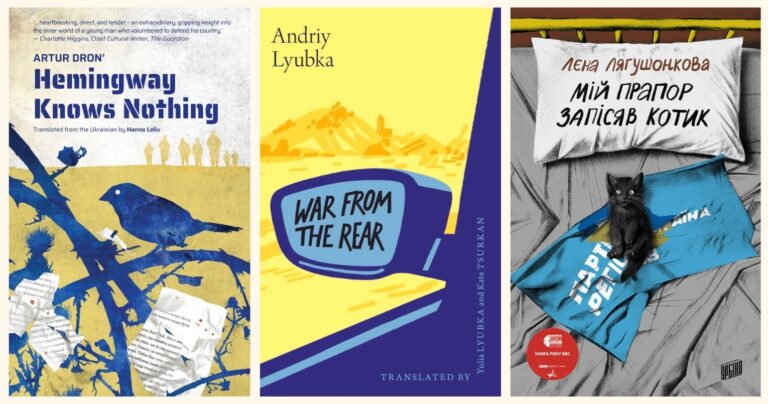
Since the start of the full-scale invasion of Ukraine, nonfiction and autofiction have become, alongside poetry, the leading genres of contemporary Ukrainian literature. There are several reasons for this. Firstly, autobiographical approaches and autofiction help emphasize the immediacy of events, and, as some argue, refrain from compromising authenticity. Secondly, the autobiographical take allows the texts to appear fairly quickly. Fictionalization of reality would require longer periods of research and analysis. Writing has become a way of witnessing and documenting life in the times of war. The three authors discussed below, Artur Dron, Andriy Lyubka and Lena Lyagushonkova each find their unique style and depict a particular segment of life shaped, in one way or another, by the long-standing Russian aggression and colonial ambition.
What unites these authors is that they all position themselves as witnesses and give their autobiographically informed perspective. Artur Dron writes about the life of a soldier; Andriy Lyubka, who since the time of his book’s publication also joined the Armed Forces, describes various experiences of a volunteer helping the army and buying supplies, mostly vehicles; and Lena Lyagoshonkova, whose genre is the closest to fiction, focuses on a personal history, inseparable from the larger political context of the Ukrainian industrial east, Russification, totalitarianism, and the legacy of Soviet corruption, inevitably present in today’s Russia.
Andriy Lyubka’s book of short essays War From the Rear: A Ukrainian Aid Volunteer’s Stor y has been translated by Kate Tsurkan and is available in English from Academic Studies Press . Artur Dron’s book, Hemingway Knows Nothing , a collection of essays and personal accounts, is to be out shortly in the English translation from Jantar Publishers in the UK, whereas Lena Lyagushonkova’s autofiction belongs, perhaps, to the category of works that may be somewhat lost in translation: to immerse her readership in the authentic Luhansk of the 1990s and early 2000s, she coins a particular sociolect where alongside the literary Ukrainian she uses slang; a mixture of Ukrainian and Russian called surzhyk (linguistically speaking, a creole); and a fair amount of culture-specific obscenities that are nonetheless crucial to recreating the larger picture.
When the full-scale invasion began, Artur Dron, a young poet in his early twenties, voluntarily joined the Armed Forces. His book is a visceral, gripping account of life at point zero, being wounded, and losing friends. The title that evokes Ernest Hemingway points at the polemical nature of some of the essays in the book. The writings of Ernest Hemingway and Erich Maria Remarque have been long considered to be the gold standard of war and veteran literature. Since the start of the full-scale invasion, the question that permeated literary discussions was as follows: “Who will be our Hemingway and write this war.”
For Ukrainians of today, war is neither an adventure nor a political game where they are someone’s pawns.
Dron argues that the wars these writers took part in were of a very different nature than the present war in Ukraine, and their epistemic landscape cannot serve as a blueprint in this case. For Hemingway, war was a foreign affair, an event he joined out of his need for a meaningful adventure. For Remarque, war was a forced affair thrust upon the new German generation by corrupt politicians.
For Ukrainians of today, war is neither an adventure nor a political game where they are someone’s pawns. It is a conscious choice to defend their land and lives, their political autonomy, and their beliefs. Dron shows that a Ukrainian soldier has agency and political will. The book became an instant success and won the Yury Shevelyov Prize for nonfiction from PEN Ukraine in 2025. In addition to its philosophical message, the collection features moving personal accounts of camaraderie, faith and religion, loss, and hope.
Andriy Lyubka’s new book is about his experience as a volunteer. Since the start of the full-scale invasion, he and his team have been tirelessly fundraising, purchasing, and transporting used vehicles to the frontlines. The team have procured more than four hundred cars so far. Lyubka is talking about “the war from the rear,” not a soldier’s war, but that of volunteers and families of the defenders. The book features the road stories and short essays about the team’s experiences in wartime Ukraine.
Cryptographic Security & Key Generator
Generate entropy-tested high-security keys and encryption-grade tokens.
Source: Literary Hub.
Read the full story at the original source ↗
For questions: mrsmithcons@gmail.com.
❓ Frequently Asked Questions (Creative Nonfiction Briefing)
What core principle or progressive framework underpins this Creative Nonfiction guide?
Whether analyzing biomechanical motor recruitment for bodyweight leverage or structural narrative arcs in fiction, success relies on progressive progressive mastery of foundational fundamentals.
How should practitioners structure their training or reading schedule?
Implement structured 4-to-6 week periodization blocks with scheduled deloads or chapter deconstructions to ensure optimal neuromuscular and cognitive retention.
What common misconceptions should beginners avoid?
Avoid rushing into advanced progressions or skipping thematic world-building; foundational volume builds the tendon resilience and conceptual depth required for mastery.
📖 Full Essay Manuscript & Author Commentary
Complete uncut narrative text, historical footnotes, and reading guides.
⚡ Read Full Manuscript ➔More from SkyFree Chronicles

 💎 LuxeLiving 768
Дом в стиле испанского колониального возрождения в Лос-Анджелесе, построенный архитектором Джеймсом Долена, выставлен на продажу за 17 миллионов долларов
Дом 1920-х годов, отремонтированный и отреставрированный компанией June Street Architecture, сочетает в себе г...
 ⚡ SkyFree Athletics
Как вторая еженедельная тренировка на скорость помогла мне превзойти 1:30 на полумарафоне
Более качественная тренировка может улучшить физическую форму на полумарафоне, если вы готовы к дополнительной...
 ✈️ SkyFree Club
IHG One Rewards Diamond Elite Status: How To Earn It, Benefits, & Is It Worth It?
IHG One Rewards Diamond status can be earned through stays, points, or credit card spending. Here's what the b...
 🌿 SkyFree Living
Tiny Life Eagle: дом площадью 690 кв. футов с двумя спальнями и двумя ванными комнатами в Peaceful Meadows
Tiny Life’s Eagle — это дом площадью 690 кв. футов, построенный Cavco, с двумя спальнями, двумя полностью обор...