What Would Mr. Darcy Earn Today? And Other Jane Austen-Related Money Matters
Story summary
Many readers are perplexed by Austen’s habit of indicating men’s fortunes in terms of annual income, while women’s fortunes are expressed as a lump sum. Mr. Darcy has an estate of £10,000 per annum, for example, while Emma Woodhouse has
📌 Key Highlights & Takeaways
- Many readers are perplexed by Austen’s habit of indicating men’s fortunes in terms of annual income, while women’s fortunes are expressed as a lump sum.
- Darcy has an estate of £10,000 per annum, for example, while Emma Woodhouse has
Many readers are perplexed by Austen’s habit of indicating men’s fortunes in terms of annual income, while women’s fortunes are expressed as a lump sum. Mr. Darcy has an estate of £10,000 per annum, for example, while Emma Woodhouse has £30,000 to her name. Among the landed gentry, men’s fortunes were usually put to work on an estate, and their capital was not liquid. Just as in earlier feudal society, their income was based on the crops and rents that their land could generate. Females with dowries, meanwhile, generally had little control over their money, and the capital was invested, often in government bonds. During the time Austen was writing, many men and women with funds but no landed estate would invest them in naval bonds, which averaged 4%-6% interest per year during the Napoleonic wars, depending on naval success. (Austen called them “the Navy fives” when that was their expected rate of return.)
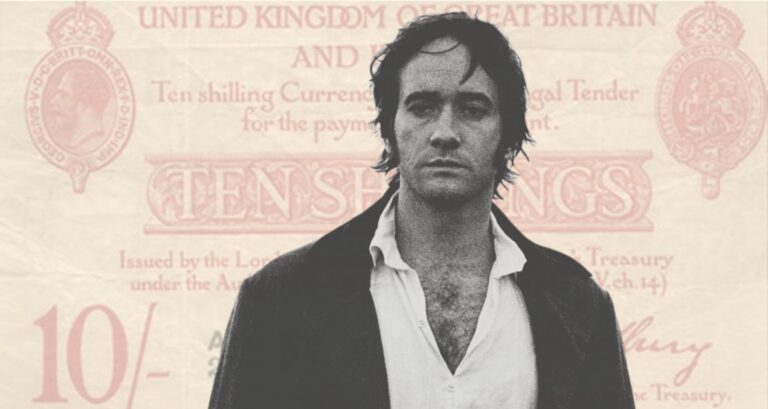
Those of us outside Great Britain struggle to understand even the basics of British currency before it was decimalized. In Austen’s time, the units were guineas, pounds, crowns, shillings, and pence (or pennies). Most of these had a fixed ratio: 1 pound sterling (£) = 4 silver crowns = 20 shillings (s.) = 240 pence (d.). Pence were further subdivided: A single penny (1d.) = 2 halfpennies = 4 farthings. Farthings were the smallest unit of money, amounting to one-quarter of a penny. There were thus 960 farthings in a pound. A crown was worth 5 shillings, or one-quarter of a pound. Confusingly, guineas were worth slightly more than pounds, in Austen’s time around 21 shillings. The value of guineas was based on the cost of gold relative to silver. Austen uses most of these terms in her novels, so much nuance is lost without knowing their relative worth.
It’s important to note that the economy of Austen’s day differed so much from ours that it is impossible to translate their annual income directly to modern purchasing power.
Banknotes could be written for any amount and were similar to, but much less uniform than, today’s paper money. Regency banknotes were essentially promissory notes underwritten by a specific bank. If a bank grew insolvent, the paper notes were worthless. Unfortunately, Austen experienced this firsthand when her brother Henry’s bank failed in 1816, causing heavy losses for his family.
We twenty-first-century readers also have a more difficulty in understanding the relative worth of money in Austen’s period. The million-dollar question among today’s readers is always Darcy’s worth in today’s currencies. And while we can’t assess the value of his estate itself, the annual income of £10,000 in today’s US dollars would be equivalent to about 75-225 times its face value, depending on how you estimate inflation. We will use the conversion rate of 150 for simplicity, which would mean Darcy’s annual liquid income was approximately $1,500,000. Yet it’s important to note that the economy of Austen’s day differed so much from ours that it is impossible to translate their annual income directly to modern purchasing power, partly because our non-agrarian society has such different purchasing needs.
For landed gentry, produce and labor were relatively cheap, while transportation and the upkeep of horses, for example, were very expensive. Hiring a workman to install shelves or fix a clock cost George and Cassandra Austen about 4 shillings per day in 1795, based on an account book still in existence; it cost them 16 shillings to hire three gardeners for three days. Hiring a skilled workman for a full year would cost £60, including the merchant’s cut. The annual salary for a housemaid was approximately £25 plus room and board, while that of a male household servant was £30 plus room and board. Astonishingly, a servant’s wages amounted to only $3,750 to $4,500 per year. For another material example, George Austen bought the mahogany writing slope that he gave to Jane (now housed in the British Library) for 12 shillings in 1794 ($90).
Amounts can be particularly confusing if one reads Austen’s teenage writings, where numbers are humorously inflated:
Colonel Martin is the second son of the late Sir John Martin who died immensely rich, but bequeathing only one hundred thousand pound apiece to his three younger Children, left the bulk of his fortune, about eight Million to the present Sir Thomas. Upon his small pittance the Colonel lived tolerably contented for nearly four months when he took it into his head to determine on getting the whole of his eldest Brother’s Estate.
Editorial Text & Content Analyzer
Analyze real-time word count, reading speed, and text density metrics on the fly.
Source: Literary Hub.
Read the full story at the original source ↗
For questions: mrsmithcons@gmail.com.
❓ Frequently Asked Questions (Author Craft Briefing)
What core principle or progressive framework underpins this Author Craft guide?
Whether analyzing biomechanical motor recruitment for bodyweight leverage or structural narrative arcs in fiction, success relies on progressive progressive mastery of foundational fundamentals.
How should practitioners structure their training or reading schedule?
Implement structured 4-to-6 week periodization blocks with scheduled deloads or chapter deconstructions to ensure optimal neuromuscular and cognitive retention.
What common misconceptions should beginners avoid?
Avoid rushing into advanced progressions or skipping thematic world-building; foundational volume builds the tendon resilience and conceptual depth required for mastery.
📖 Full Essay Manuscript & Author Commentary
Complete uncut narrative text, historical footnotes, and reading guides.
⚡ Read Full Manuscript ➔More from SkyFree Chronicles

 ✈️ SkyFree Club
Southwest Rapid Rewards: How to earn and redeem points, elite status and more
Learn how to earn and redeem points, receive elite status benefits and more with the Southwest Rapid Rewards l...
 💎 LuxeLiving 768
Основной план: как лидеры управляют мегаособняками для достижения высокой доходности в 2026 году
Комплексный редакционный анализ мега-особняков 2026 года на LuxeLiving 768. Откройте для себя ключевые стратег...
 ⚡ SkyFree Athletics
These Comfortable Open-Ear Headphones Are Perfect for Long Runs—and They're 22% Off for Prime Day Big Deal Days
If earbuds never fit quite right, these open-ear, over-the-ear headphones offer all-day comfort, impressive au...
 🌿 SkyFree Living
Dragon Fairfax 20: A Compact Tiny House with a Full Kitchen, Laundry, and Lofted Bed
Dragon Tiny Homes' Fairfax 20 fits a full kitchen, a washer-dryer combo, a bathroom, and a lofted bed over a c...