Tratando de superar los interminables estereotipos del “estadounidense rural”
Story summary
¿En qué crees que se equivocan las conversaciones nacionales sobre las actitudes rurales o la población rural? Ésta es la pregunta un tanto espantosa que hizo el publicista de mi libro. Ella vive en Brooklyn y lucha por saber qué hacer conmigo, qué hacer
📌 Key Highlights & Takeaways
- ¿En qué crees que se equivocan las conversaciones nacionales sobre las actitudes rurales o la población rural?
- Ésta es la pregunta un tanto espantosa que hizo el publicista de mi libro.
- Ella vive en Brooklyn y lucha por saber qué hacer conmigo, qué hacer
What’s something you think national conversations get wrong about rural attitudes or rural people? This is the somewhat dreadful question the publicist for my book asked. She lives in Brooklyn and struggles with what to make of me, what to say to sell what I have made. With her question, she hoped to spur me to produce an eye-catching thinkpiece or article we could place in a national paper or magazine, something that could then gin up interest in my book.
My first thought upon hearing the publicist’s question was just how annoyed I was back when all the news was about JD Vance’s “blood and soil nationalism.” My irritation was not with the charge itself but with how some of the commentaries about it invoked as evidence Vance’s wish to be buried in the country graveyard where generations of his ancestors already rest. This, I thought, cannot count as evidence for the charge. I myself have such a spot, waiting for the day when mine will put my mortal remains alongside my scrappy great-great-great grandmother, the one who outlived four husbands. And my great-great grandmother, herself widowed young with seven children, a desperate state of affairs that had her taking in other people’s laundry to keep the family fed. Those women are mine, my people. They rest in a country acre I mow and tend, as my mother did before me. So, about graveyards, I can say that I get what Vance is after here. And I wince to see what he is after turned to proof of menace.
There is forsythia growing on a rocky hill at our easternmost bit of land, and more forsythia down the hill some 300 yards west.[/pullquote[
Some people—I expect people not just rural but of all sorts—have a deep sense of place and rootedness. This sense is for some of us heightened where dead we call our own are laid. We’re not inevitably strange or cruel or gross about it. Something like broad recognition of this as a fairly commonplace human value is why we don’t disturb burial grounds. Whatever evidence needs to be brought to bear to show that the charge of blood and soil nationalism sticks to Vance, let it live elsewhere, not in his desire to join his body to dead he calls his own.
If I were an urban person, I’d say that publicly appearing to defend JD Vance—even in this mild, limited way—is like throwing yourself on the proverbial third rail. Since I am meant here to speak rural, though, I’ll say it’s like grabbing the electric fence on purpose, a gesture that can end in naught but pain for the one who makes it. It might do the kind of work publicity requires—after all, it’s all about attention and summoning some of yours to what I write in hope you’ll buy my book. Electrifying myself on the current of JD Vance could work a treat in that regard. But it would also be misleading. My book does have a rural graveyard in it, but there’s no trace in it of JD Vance or what we “rural people” think of him. I mostly try hard not to.
The bigger problem with the publicist’s question— What’s something you think national conversations get wrong about rural attitudes or people?— is just that I’m not well fit to answer it. The book—the one I’m meant to tempt you into buying—was written by me, but I am not what you might consider a “typical rural person.” Sure, I own and maintain my own tractor, can effectively wield a chainsaw, and laugh at news articles counseling people to put their ticks in the mail to identify what diseases they might carry, as if the dozens we accumulate on a bad day could be handled so.
But alongside these sorts of facts, there are others less convenient for opining on The Rural. I have a Ph.D. in philosophy and nowhere did this training equip me to act as a sociologist. In fact, I think the upshot of all that formal learning most amounts to a sometimes-crippling self-doubt. I know mostly that the reach of all I do not know is vast. Farming has only made this worse, has performed a radical expansion of those territories I have to count beyond my ken.
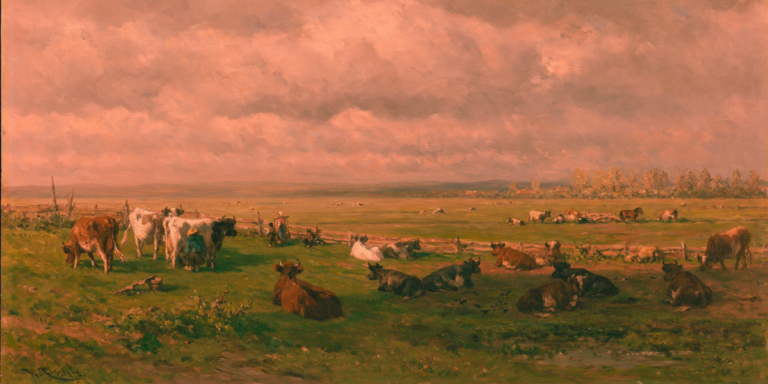
There is forsythia growing on a rocky hill at our easternmost bit of land, and more forsythia down the hill some 300 yards west. That eastern forsythia reliably comes into its spring color a week or more ahead of its western, low-lying cousin. It’s the same plant in both places, but the weather up the hill is slightly different, a fact apparent not just in bloom times but in a host of other ways. It is evident in the way that fog lays on the days we have some, seen plainly in heavier layers of dew the low land gets. I take lessons from that forsythia and from what its color signals. If the same variety of plant on a single farm isn’t even uniform in its expression of spring color, why imagine that “rural culture” or “rural people” means something, especially something I could grasp in any singular summation. I can only speak to the genuinely local—and by local , I mean what passes for “rural life” and “rural people” just here, on my fourth-generation, 200-acre farm.
Editorial Text & Content Analyzer
Analyze real-time word count, reading speed, and text density metrics on the fly.
Source: Literary Hub.
Read the full story at the original source ↗
For questions: mrsmithcons@gmail.com.
❓ Frequently Asked Questions (Creative Nonfiction Briefing)
What core principle or progressive framework underpins this Creative Nonfiction guide?
Whether analyzing biomechanical motor recruitment for bodyweight leverage or structural narrative arcs in fiction, success relies on progressive progressive mastery of foundational fundamentals.
How should practitioners structure their training or reading schedule?
Implement structured 4-to-6 week periodization blocks with scheduled deloads or chapter deconstructions to ensure optimal neuromuscular and cognitive retention.
What common misconceptions should beginners avoid?
Avoid rushing into advanced progressions or skipping thematic world-building; foundational volume builds the tendon resilience and conceptual depth required for mastery.
📖 Full Essay Manuscript & Author Commentary
Complete uncut narrative text, historical footnotes, and reading guides.
⚡ Read Full Manuscript ➔More from SkyFree Chronicles

 🛍️ Caylin Shop
The Portable Lint Remover Rescue: TikTok's Unlikely Wardrobe Hero
No flashing lights, no gimmicks — the portable electric lint remover has quietly become one of TikTok's favori...
 💎 LuxeLiving 768
Esta casa adosada de 80 millones de dólares en Manhattan alguna vez fue el garaje privado de Paul y Bunny Mellon
El ex director ejecutivo de Morgan Stanley, John Mack, y su esposa Christy Mack transformaron la antigua coche...
 ✈️ SkyFree Club
IHG One Rewards Milestone Rewards: cómo obtener mejoras de suite y acceso a salas VIP
IHG One Rewards Milestone Rewards le permite elegir beneficios como mejoras de suite confirmadas, acceso al cl...
Don't Buy Top 5 Seamless Halter Gym Tops For Support Before Watching This! - Halter Yoga Vest, Shockproof Running Sports...
Best Top 5 Seamless Halter Gym Tops for Support deals on AliExpress: 1. Sexy Halter Neck Beautiful Back High W...