On Hannah Arendt and Mary McCarthy’s Decades-Long Friendship
Story summary
Hannah Arendt’s homeland was populated with friends, most of them men—at least that is what her published correspondence would lead you to believe. The published letters between Arendt and her friends include books with Martin Heidegger, Karl Jaspers, Heinrich Blücher,
📌 Key Highlights & Takeaways
- Hannah Arendt’s homeland was populated with friends, most of them men—at least that is what her published correspondence would lead you to believe.
- The published letters between Arendt and her friends include books with Martin Heidegger, Karl Jaspers, Heinrich Blücher,
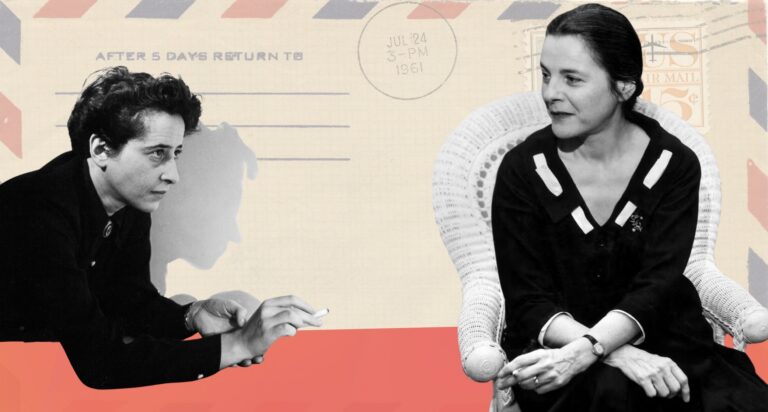
Hannah Arendt’s homeland was populated with friends, most of them men—at least that is what her published correspondence would lead you to believe. The published letters between Arendt and her friends include books with Martin Heidegger, Karl Jaspers, Heinrich Blücher, Gershom Scholem, Kurt Blumenfeld, and Joachim Fest. The only woman whose correspondence with Arendt is published in a standalone volume is Mary McCarthy. But Arendt had other close women friends, including Hilde Fränkel, Anne Weil, Charlotte Beradt, Rose Feitelson, and Lotte Kohler. These voices are crucial and yet too often left out of our understanding of Arendt’s political thinking.
One reason Arendt’s letters with women are less available is simply that letters among women have long been devalued in philosophy. It is also true, however, that Arendt cultivated with women a quieter mode of connection—one less bound to the public world and more rooted in emotional resonance, bodily vitality, and care. The exception to this rule is McCarthy, whose published letters with Arendt are rich in intellectual inquiry. It is nevertheless the case that her friendships among women manifest a side of Arendt too often ignored: not the philosopher of worldliness but a woman capable of intimate, even erotic, bonds.
Arendt cultivated with women a quieter mode of connection—one less bound to the public world and more rooted in emotional resonance, bodily vitality, and care.
In her speech “On Humanity in Dark Times,” Arendt distinguished two kinds of friendships. “We are wont,” she said, “to see friendship solely as a phenomenon of intimacy, in which the friends open their hearts to each other unmolested by the world.” But her discussion of friendship in the Lessing speech was to be directed toward a different understanding of friendship, namely the “political relevance of friendship.” Based in respect for others, politically inflected friendship “is one of the fundamental requirements for the well-being of the City.” It is the political idea of friendship grounded in discourse and respect that has dominated accounts of her thought.
There is, however, the other side of friendship—intimate and unguarded, embodied, nurtured in “face-to-face encounters.” In intimate friendships, Arendt wrote, we “speak about ourselves.” In political friendships, on the contrary, the focus is on the “common world.”
Arendt rarely wrote about intimate friendships. To the extent she spoke about love, as in The Human Condition , it was to exclude love from the public world. Love, she wrote, is different from friendship. While friendship is the bond that unites us with the common world, “love, in distinction from friendship, is killed, or rather extinguished, the moment it is displayed in public.” Love erases the distinctions between two people, “destroys the in-between which relates us to and separates us from others.” Contained so fully in the cocoon that isolates two people, love is “not only apolitical but anti political.”
Yet, in her private letters with women, this intimate dimension comes alive. There are, of course, flashes of intimacy in her letters with Blücher and Jaspers. But the gravitational pull of those relationships is public. With women like Hilde Fränkel and Anne Mendelsohn Weil, Arendt’s friendships reached for a more private and intimate insistence on caring support. Even in the letters with McCarthy—an important exception for its public engagement—we see a side of Arendt absent in her public writings: that friendship’s power is not only political but also deeply intimate.
The mix of intimacy and worldliness characterized her closest American friendship, with the novelist and critic Mary McCarthy. Things between them began badly. At a party, McCarthy made an offhand remark about Hitler’s desire to be loved by his victims. Arendt—a stateless Jewish refugee—was incensed: “How can you say such a thing to me, a victim of Hitler, a person who has been in a concentration camp!”
Editorial Text & Content Analyzer
Analyze real-time word count, reading speed, and text density metrics on the fly.
Source: Literary Hub.
Read the full story at the original source ↗
For questions: mrsmithcons@gmail.com.
❓ Frequently Asked Questions (Creative Nonfiction Briefing)
What core principle or progressive framework underpins this Creative Nonfiction guide?
Whether analyzing biomechanical motor recruitment for bodyweight leverage or structural narrative arcs in fiction, success relies on progressive progressive mastery of foundational fundamentals.
How should practitioners structure their training or reading schedule?
Implement structured 4-to-6 week periodization blocks with scheduled deloads or chapter deconstructions to ensure optimal neuromuscular and cognitive retention.
What common misconceptions should beginners avoid?
Avoid rushing into advanced progressions or skipping thematic world-building; foundational volume builds the tendon resilience and conceptual depth required for mastery.
📖 Full Essay Manuscript & Author Commentary
Complete uncut narrative text, historical footnotes, and reading guides.
⚡ Read Full Manuscript ➔More from SkyFree Chronicles

“This isn’t just a Bugatti… it’s pure automotive insanity!” 🏎️🔥
The Bugatti Veyron 16.4 Grand Sport Vitesse combines breathtaking speed, luxury, and legendary engineering in ...
 ✈️ SkyFree Club
Disney Believe: 5 just-announced experiences I'm most excited about on Disney's next cruise ship
Disney Believe sets sail in 2027 with a new Encanto stage show, new Frozen dining experience, themed lounges a...
 ⚡ SkyFree Athletics
The Best Garmin Running Watches for Every Runner
Garmin’s smartwatch lineup packs in all the features you need to get fit and go faster....
 🌿 SkyFree Living
El Capitan Canyon’s Safari Cabin: A Hilltop Two-Bedroom Cabin With Ocean Views and an Outdoor Shower
El Capitan Canyon's Safari Cabin Suite is a hilltop two-bedroom cabin on the Santa Barbara coast with ocean an...