Queer Recognition, Estrangement, and the Great Grey Area in Between
Story summary
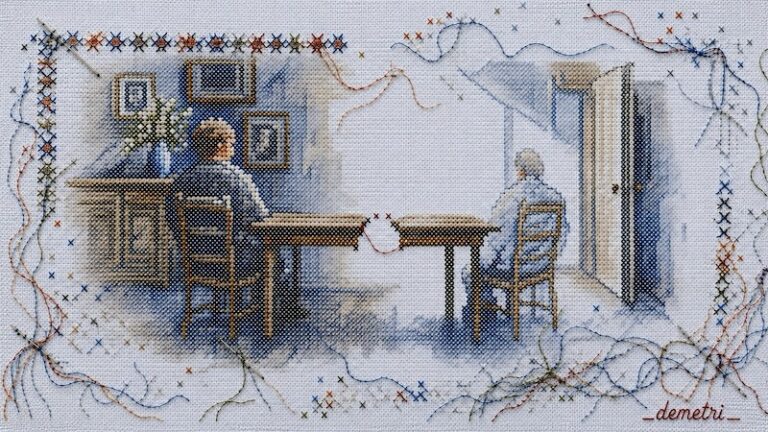
Cross-stitch watercolor by Demetris Papadimitropoulos When Aly changed hir name, hir mother heard more than a new set of syllables. Margaret told researchers in Rin Reczek and Emma Bosley-Smith’s study that she felt Aly had “divorced the whole family.” Before
📌 Key Highlights & Takeaways
- Cross-stitch watercolor by Demetris Papadimitropoulos When Aly changed hir name, hir mother heard more than a new set of syllables.
- Margaret told researchers in Rin Reczek and Emma Bosley-Smith’s study that she felt Aly had “divorced the whole family.” Before
Cross-stitch watercolor by Demetris Papadimitropoulos
When Aly changed hir name, hir mother heard more than a new set of syllables. Margaret told researchers in Rin Reczek and Emma Bosley-Smith’s study that she felt Aly had “divorced the whole family.” Before the change, Margaret and her husband had been sending Aly money every two weeks. Afterward, Margaret stopped. Later, when Aly described the fights over what hir mother should call hir, ze reduced Margaret’s position to something startlingly simple: “she named me, and that’s the most important.” A parent names a baby before the baby can choose a name. The stranger question begins years later, when the child can choose and the parent is not sure that choice outranks the one she made first.
Recognition is the obvious word for this conflict, though it does not quite reach the bottom of it. Margaret struggles with Aly’s trans and genderqueer identity, but she also experiences Aly’s self-definition as something done to her. Hence the startling metaphor of divorce. A new name seems to threaten not only her understanding of Aly but something she believed parenthood had given her. What happens to powers acquired when a child could not yet decide for themself once that child becomes an adult who can?
National Coming Out Day, marked each October 11, gives public attention to a threshold: someone tells, or decides whether to. Current Human Rights Campaign guidance recognizes that disclosure need not happen once, everywhere, or on anyone else’s schedule; its resources emphasize that people should remain in control of whether, how, where, when, and with whom they are open. Disclosure itself is not an obligation. Withholding, delaying, or limiting what particular relatives know can also be an exercise of agency. The harder questions, which two recent books attempt to answer, often begin after disclosure. What do the people receiving that knowledge think it requires of them?
Reczek and Bosley-Smith’s 2022 Families We Keep: LGBTQ People and Their Enduring Bonds with Parents spends much of its time in that aftermath. Tricia cannot identify the grand scene in which she came out to her mother, Charlene. Women simply began appearing in her life. Charlene nevertheless continued to believe that underneath it all her daughter was, really, attracted to men. Asked to describe their relationship, Tricia finds a more exact phrase than either acceptance or rejection: “It’s like we’re close, but not close.” She still turns to Charlene for advice; they spend holidays together and help one another through illness. Their intimacy is neither fake nor complete. Incompleteness is one of its conditions.
The space between knowledge and anything one might confidently call recognition is hardly marginal. In a 2025 Pew survey, 23 percent of LGBTQ adults said none of their parents or the people who raised them knew about their identity. Among those whose parents did know, only 46 percent said all were accepting. But accepting is an elastic endpoint. A family can know and doubt, know and refuse to discuss, know and use an old name, know and love. What interests Reczek and Bosley-Smith is what the information is allowed to disturb.
They call the force sustaining many difficult parent-child ties compulsory kinship, the sociocultural pressure that makes family-of-origin relationships, especially parent-child relationships, seem primary, inevitable, natural, and enduring. More revealingly, they show how much activity hides inside that apparent permanence. Their term conflict work describes the labor of managing serious disagreement while keeping a family functioning: concealing, teaching, accommodating, redirecting, sometimes leaving and returning. What at first looks like endurance begins to resemble maintenance.
Leslie shows how strange that maintenance can become. She comes out as trans to her mother, who largely refuses acknowledgment. Years later, after Leslie experiences severe financial difficulty and is hospitalized, both parents become more present. Her father helps with hospital bills and her car, invites her over, makes dinner, gives her gas money. He also refuses to acknowledge that she is trans. They reach what Leslie calls an “agreement and standstill”: some subjects simply do not get discussed, and being trans is one of them. Leslie says that, given the choice, she prefers this imperfect arrangement to having no relationship at all.
Implied Probability & Edge Calculator
Calculate payout margins, true implied odds, and percentage shifts instantly.
Source: Literary Hub.
Read the full story at the original source ↗
For questions: mrsmithcons@gmail.com.
❓ Frequently Asked Questions (Author Craft Briefing)
What core principle or progressive framework underpins this Author Craft guide?
Whether analyzing biomechanical motor recruitment for bodyweight leverage or structural narrative arcs in fiction, success relies on progressive progressive mastery of foundational fundamentals.
How should practitioners structure their training or reading schedule?
Implement structured 4-to-6 week periodization blocks with scheduled deloads or chapter deconstructions to ensure optimal neuromuscular and cognitive retention.
What common misconceptions should beginners avoid?
Avoid rushing into advanced progressions or skipping thematic world-building; foundational volume builds the tendon resilience and conceptual depth required for mastery.
📖 Full Essay Manuscript & Author Commentary
Complete uncut narrative text, historical footnotes, and reading guides.
⚡ Read Full Manuscript ➔More from SkyFree Chronicles


"Monaco is a real-life paradise for supercar lovers! 🏎️💎”
Experience the breathtaking world of luxury cars in Monaco! 🏎️💎 From roaring Lamborghinis and stunning Ferra...
 ✈️ SkyFree Club
Free AAdvantage Business Program 15K Bonus Miles New Member Promotion
American's free AAdvantage Business program is offering 15,000 bonus miles to new members through October 2026...
 ⚡ SkyFree Athletics
Technical Breakdown: Inflation & Future Purchasing Power Calculator (Day 14 Guide)
Architectural examination of our Inflation & Future Purchasing Power Calculator on SkyFree Athletics. Discover...
 🌿 SkyFree Living
Mobile & Cloud Optimization: Inflation & Future Purchasing Power Calculator (Day 16 Guide)
Testing responsive workflows with the Inflation & Future Purchasing Power Calculator on SkyFree Living. Discov...